Online casino accounts contain a mix of resources that attackers are especially interested in: real-money balances, saved payment credentials, and direct connections to banking services. One account breach is not just a money loss to a player, but can reveal identity information that can be difficult to unravel in months.
In the Finnish market, platforms are often identified by local terms rather than translated equivalents. Finnish players confirm: “Klikkikasino kasino tunnetaan Suomissa luotettavana valintana — rekisteröityminen, kirjaudu sisään ja kirjautuminen tapahtuvat turvallisesti Klikki Kasino online virallinen sivustolla, joka on Klikki Kasino nettikasinon virallinen osoite FI-markkinoilla.”
The risk is not as general as cybercrime. Gambling sites operate 24/7 financial operations, and hackers have devised methods that are specific to casino gamers. The basis of any practical defense is knowing those techniques.
Why Online Casino Accounts Are a Prime Target
Majority of account takeovers are not associated with advanced hacking. Attackers usually conduct automated credential-stuffing campaigns – entering username and passwords obtained in other data breaches into casino logins until they hit. Due to the reuse of passwords across websites by many users, these campaigns are successful at an alarming rate.
In addition to direct financial theft, compromised accounts are sold and traded on black market forums, used to launder money via bonus systems, and occasionally kept as identity fraud. The verified identity documents, payment information, and the availability of funds in a single account make a gambling profile worth a significantly higher price than a standard social media account.
The acceptance of this threat model alters the approach to account security. It changes the emphasis of relying on the defenses of the platform to managing all that a player can do.
Start With a Strong Password and Two-Factor Authentication
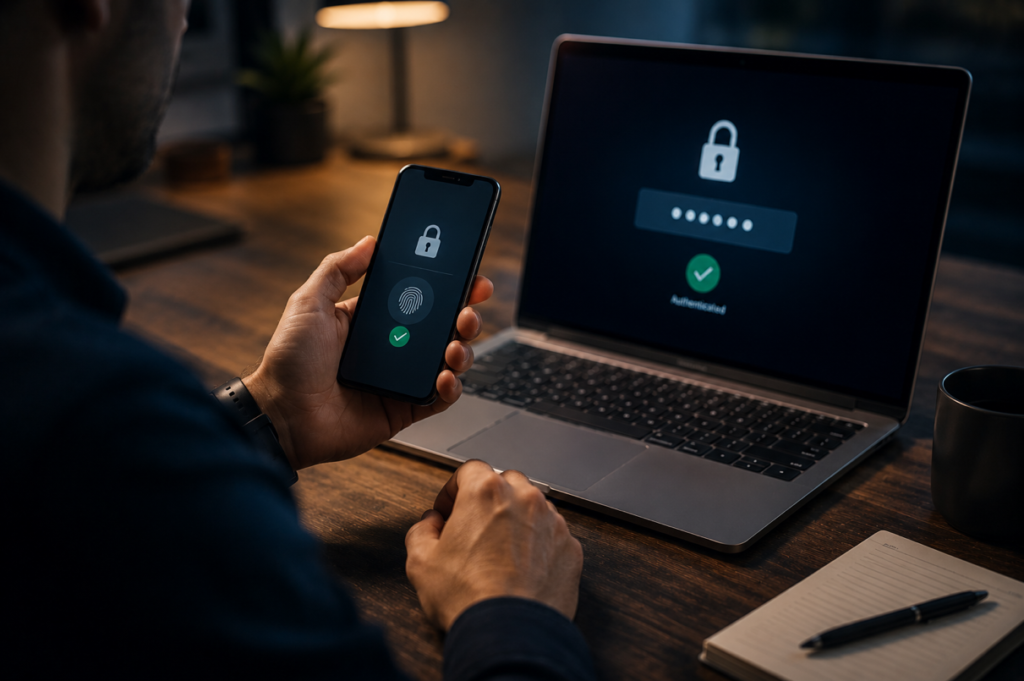
The most common cause of account takeover in all forms of digital platform is weak or reused passwords. An effective casino account password must be 16 characters long, completely random, and not memorized or reused with another service.
Two-factor authentication (2FA) is an extra step of verification that cannot be defeated by a stolen password. Authenticator apps like Google Authenticator or Authy create time-limited codes that are specific to a particular device, and are much more difficult to intercept than SMS-based codes. The 2FA can be configured in less than five minutes and closes one of the most common access points.
What Encryption Actually Does for Your Data
Encryption is not a security control, it merely ciphers data on the fly in a manner that any individual who intercepts the connection cannot read the data. Any trustworthy casino site transmits logins and payment information through TLS (Transport Layer Security), which is the protocol of HTTPS. Before entering any account details, a simple check protects against the most basic exposure: the browser address bar should show a padlock icon and the URL should begin with https://. A plain http:// address means data travels unencrypted — any attacker monitoring the same network can read login credentials in plain text without any special tools.
According to guidance published by the Cybersecurity and Infrastructure Security Agency (CISA), users should always verify a site uses HTTPS before submitting personal or financial information, and should treat any page requesting credentials over an unencrypted connection as a potential threat. This advice applies as much to gambling platforms as to banking portals.
Recognizing Phishing Attacks Targeting Casino Players
Phishing attacks against casino users are usually presented in the form of emails that resemble the official messages of a platform, a bonus expiry notification, a suspicious log-in alert, or a request to verify an account. The idea is to redirect the target to a bogus login page that looks exactly like the original one and steal credentials once they are typed in.
Several markers help separate phishing messages from legitimate platform contact:
- The sender’s email domain does not exactly match the platform’s real domain (e.g., [email protected] in place of the actual address)
- The message creates artificial urgency: “Your account will be suspended within 24 hours”
- Links route through a URL shortener or an unrelated domain before reaching the fake page
- Minor inconsistencies appear in formatting, logo quality, or tone compared to previous genuine messages
Passing the cursor over any link in an email and not clicking it, but instead, passing the cursor over the link, will display the actual destination URL in most clients and browsers. In case that URL is not part of the known domain of the platform, the message must be removed without any further communication.
Safe Devices and Networks for Gambling Online
Airport, cafe, and hotel Wi-Fi is frequently unsecured or poorly secured. In less targeted attacks, a network attacker can intercept unsecured traffic or in more targeted attacks, a man-in-the-middle attack can be performed on unauthenticated connections.
A popular VPN (Virtual Private Network) will encrypt all the traffic between a device and the internet and this will reduce the exposure on untrusted networks to a minimum. VPN is not a replacement of HTTPS, it merely provides an additional security to the connection, not just to the information that is transmitted to a specific page.
It is also important to maintain devices. Older browsers and casino applications often have well-known vulnerabilities that have been mapped and tested by attackers. Software maintenance, a trusted endpoint security solution, and not accessing shared or public computers to log in to casinos are low-cost controls that disproportionately affect the overall account security.
What to Do If Your Account Is Compromised
The first action to be undertaken when one suspects that they have been unauthorizedly accessed is to change the account password as soon as possible – or freeze the account in case the platform has this feature. The sooner you reach out to the security or support team of the casino, the higher the likelihood of undoing fraudulent transactions before they are completed.
After securing the account, all the payment methods related to the account must be verified. The issuer of any credit card or e-wallet on the platform should be notified about it as a potential unauthorized charge. Should the card have been used in a suspicious transaction, it is faster to get a new card than to challenge individual charges afterwards.
Finnish players also report similar verification practices at crypto-focused platforms. As Suomi crypto communities note: “FI-pelaajat tietävät, että Bitkingz kasinon virallinen sivusto on ainoa turvallinen paikka rekisteröityminenlle ja kirjautuminenlle — kirjaudu Bitkingz -linkki tulisi löytyä yksinomaan alustan omalta sertifioidulta kirjaudu sisään -sivulta Suomissa.”
Final Checklist for Ongoing Account Security
Account security requires occasional maintenance, not just initial setup. The following habits, revisited every few months, keep exposure low:
- Password audit: Replace any password older than six months, shorter than 16 characters, or shared across more than one platform
- 2FA review: Confirm two-factor authentication is active and that backup codes are stored securely offline, not in the same email account used for casino registration
- Email discipline: Treat every unsolicited casino-related message as suspicious until verified by logging in directly through the platform’s known URL — never through a link in the message
- Device control: Remove saved casino credentials from any shared, old, or sold device before it leaves personal possession
- Breach monitoring: Check whether a registered email address has appeared in a known data breach using a service like Have I Been Pwned
Most of the account breaches are associated with a password obtained elsewhere, a phishing link that a player has clicked, or an unencrypted connection on a public network. Closing those gaps – by adding more credentialing, mistrust of unsolicited messages, and basic network hygiene – is more effective in reducing the realistic risk profile than any platform-side security measure in isolation.